
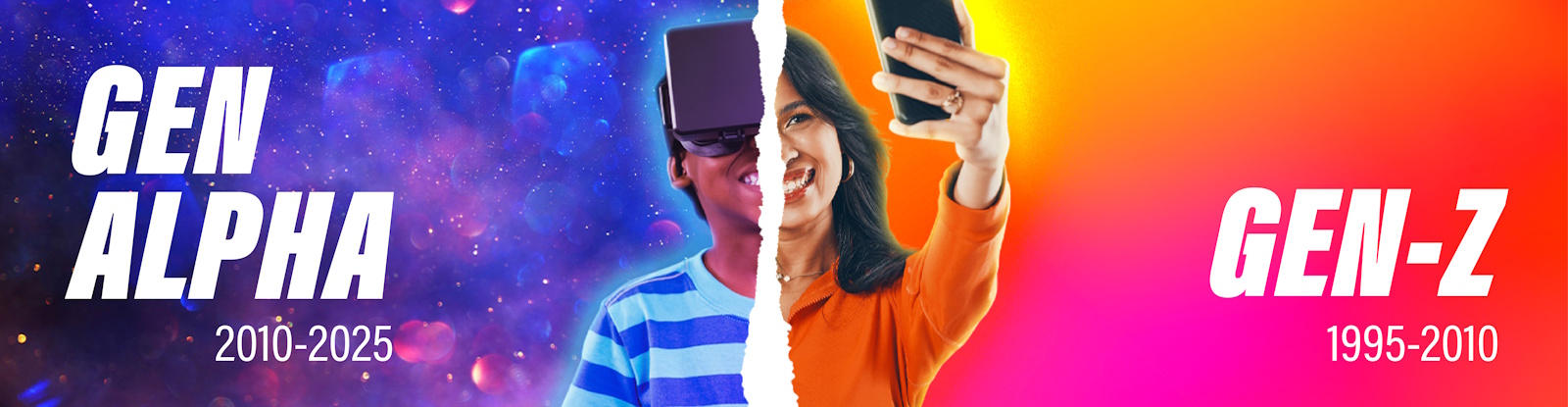
With all the doom and gloom messaging about the “demographic cliff” over the past several years, you may have missed the fact that we are on the precipice of Gen Alpha replacing Gen Z as the primary audience for higher education marketing. With birth dates of 2010 and later, the first cohort of Gen Alpha students will graduate high school in 2028, which means that your Sophomore/Junior search campaign this year will need to straddle two generations, with an emphasis on the next generation.
In preparation for this paradigm shift, let’s walk through some of the defining characteristics of Gen Alpha, where and how they differ from Gen Z, and what these shifts mean for your institutional structure and marketing needs going forward. So, while acknowledging that no generation is a monolith, let’s dig into some of the overarching characteristics that show up throughout Gen Alpha.
Who is Gen Alpha, and what makes them tick?
- Raised by Millennial parents (a topic for another time!): Gen A has been introduced to complex topics around mental wellness and self-care.
- Tech natives with AI expectations: Screens have been an ever-present reality of their lives from birth. To them AI isn’t a tool for hacking life’s challenges. It’s a standard part of daily life, and the expectation of immediate answers and outcomes is non-negotiable.
- Groomed as savvy consumers: The prevalence of technology in their lives has nurtured an extremely brand-conscious generation. Reputational awareness and brand loyalty are paramount to their decision making.
- The most diverse generation: Alpha is primed to be the most racially and ethnically diverse generation in history. Combine that fact with the availability of global brands and trends and you get a generation of young people who truly see themselves as citizens of world.
- Gamers and builders: Growing up in front of screens has been a double-edged sword for Gen A. On the one hand, virtual worlds such as those in games like Minecraft and Roblox have enabled them to develop a keen sense of aspiration and creative vision. While short-form social media platforms like TikTok and YouTube have contributed to the development of a significantly shorter attention span.
- Pragmatists at heart: Unlike Gen Z, who largely view themselves as change agents who want to be seen as expressing themselves fully and authentically, Gen A are raised by parents who suffered through the Great Recession and COVID pandemic. Their motivations largely revolve around building a secure future and improving upon the status quo.
What are the key differentiators between Z & A?
| Topic | Gen Z | Gen Alpha |
|---|---|---|
| Technology | Digital Pioneers: They grew up along with digital media and smart phone technology | True Natives: They were born into a well-established, digitally integrated world. Screens, algorithms & AI are facts of life |
| Social Media | Content-Drive Curators: Early adopters of short-form platforms like Snapchat & TikTok. Feedback (likes) and perception are key motivators | Observers: Primarily video platform focused. Social media is mostly a tool for communication with their inner circle, not the world at large |
| Social Activism | Disruptors: The “change the world” generation looks for opportunities for broad-scale impact. (i.e. protests, social media activism, etc.) | Accountability Drivers: They see structural problems and look to hold the people in charge accountable for fostering the needed changes |
| Educational Preferences | Side Hustlers: They seek path of least resistance opportunities to achieve success. Course flexibility is of prime interest, and the availability of online and video learning options gives them a sense of autonomy. | Interactive Gamers: True digital natives, they thrive in gamified environments where they can learn through interactive virtual experiences, or “Edutainment” |
| Core Motivations | Self-expression and disrupting the status quo | Mastery of “the system” and building a secure future early in life |
What does it all mean?
For the enrollment marketer, these differences and changes (some subtle, some profound) necessitate a complete reframing of your institution’s approach to messaging as well as a shift in the tactics used to make meaningful contact with your new target audience.
- Trade lofty, idealist rhetoric for pragmatic, results-oriented information: Gen Z responded to “Discover the real YOU” and “Become the change agent”. Gen Alpha would like to know exactly how it is that your institution is going to enable them to achieve and secure the future that they dream of.
- Don’t confuse heavy screen usage as a lack of interest in community: Gen A has been raised on portable, interactive technology. Screens are second nature. They are an extension of the person themselves. Instead of meeting face to face and hanging out at the mall, Gen A is creating virtual worlds and meeting up with their friends in those spaces. Digital interaction is equal to, if not greater than, physical interaction. So, get comfortable communicating in spaces that are new to you.
- Gamification is key: This generation is not interested in being marketed to. They are seeking real-time, interactive, and immersive opportunities to explore and learn. Create ways to encourage actual engagement. (Hint: Clicking a link in an email doesn’t qualify!)
- Fully integrate AI into your messaging strategy: Gone are the days of creating a static comm flow and watching its impact on your enrollment funnel. Gen Alpha demands the information they need at the time they decide they need it. Business hours are a hindrance to progress. AI agents can help your institution be ever-present, service-oriented, and proactive in communicating at scale with your prospect pool.
After decades of learning about and communicating with Gen Z in the recruitment marketing world, change is upon us once again. Is your institution ready?